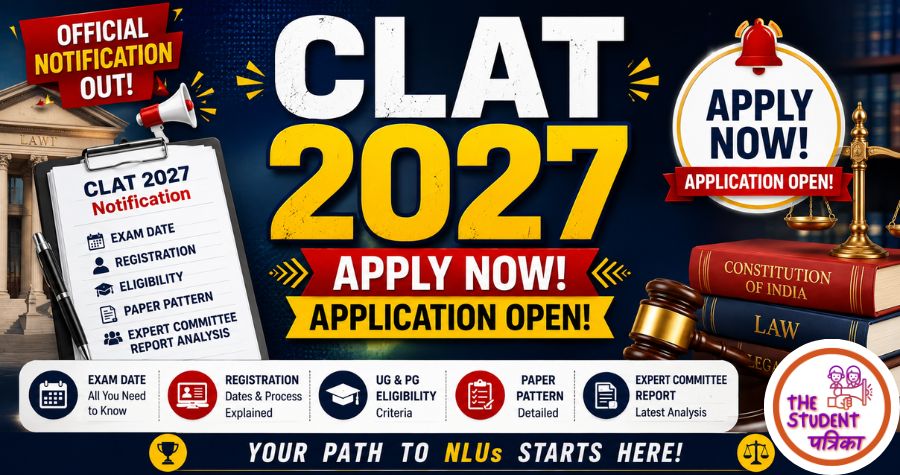
CLAT 2027 Notification Released: Exam Date, Eligibility, Paper Pattern & Expert Committee Report Highlights
If you are an aspiring lawyer planning to step into India's top National Law Universities (NLUs), the countdown for the official CLAT exam season has officially begun.
The CLAT consortium (Consortium of National Law Universities) has officially released the CLAT 2027 notification, bringing complete clarity regarding registration timelines, test dates, eligibility, and the exact paper pattern for both undergraduate and postgraduate law courses.
Here's complete information on the CLAT 2027 exam date, previous paper of CLAT 2026, or the recent Expert Committee report proposing major exam changes, on Student Patrika!
What is the CLAT Exam?
The Common Law Admission Test (CLAT) is India's premier national-level entrance test. Conducted annually by the CLAT consortium, this entrance examination serves as the gateway for admissions to 5 year integrated LL.B (undergraduate) and 1 year LL.M (postgraduate) programs across 24 participating National Law Universities and dozens of top private law colleges across India.
For law aspirants preparing for university entrances alongside exams like CUET and CUET 2027, securing a top rank in CLAT remains the primary route to entering premier law campuses in India.
Important Dates: CLAT 2027 & Timeline:
Keeping track of official deadlines is critical to ensure your application goes through smoothly. Following is the schedule for CLAT 2027:
-
Official Notification Release: July 22, 2026
-
CLAT 2027 Registration Start Date: August 3, 2026 (10:00 AM)
-
CLAT 2027 Registration Last Date: October 31, 2026
-
Admit Card Release Window: Fourth week of November 2026
-
CLAT 2027 Exam Date: Sunday, December 6, 2026 (2:00 PM to 4:00 PM)
Remember that the online portal on consortiumofnlus.ac.in will accept submissions strictly until October 31, 2026.
CLAT 2027 Eligibility Criteria:
For Undergraduate Courses (CLAT UG): To appear for the CLAT UG examination, candidates must satisfy the following academic conditions:
-
Educational Qualification: Successful completion of Higher Secondary School Examination (10+2) or an equivalent examination from a recognized board.
-
Minimum Marks: Candidates in the General, OBC, PwD, NRI, and OCI categories must secure at least 45% aggregate marks. Candidates belonging to SC and ST categories require a minimum of 40% aggregate marks.
-
Appearing Students: Students currently appearing in their 10+2 board examinations are fully eligible to apply, provided they produce proof of passing at the time of admission counseling.
-
Age Limit: The CLAT consortium specifies no upper age limit for appearing in CLAT UG.
For Postgraduate Courses (CLAT PG): For candidates targeting LL.M programs through CLAT PG 2027:
-
Educational Qualification: An LL.B. degree or an equivalent law degree from a recognized university.
-
Minimum Marks: Unreserved, OBC, and PwD category candidates require at least 50% aggregate marks, while SC and ST category candidates require 45% aggregate marks.
-
Age Limit: There is no upper age limit for CLAT PG.
CLAT 2027 Paper Pattern & Syllabus:
Despite widespread speculation regarding pattern overhauls, the CLAT consortium has officially confirmed that the paper structure for CLAT 2027 remains completely unchanged from CLAT 2026.
CLAT UG Pattern Breakdown:
- Exam Mode: Offline (Pen and paper OMR format)
- Duration: 2 Hours (120 Minutes)
- Total Questions: 120 Multiple-Choice Questions (MCQs)
- Marking Scheme: +1 mark for every correct answer, and - 0.25 negative marking for every incorrect answer.
- English Language: 22 to 26 questions (~20% weightage) testing reading comprehension, contextual vocabulary, and inference.
- Current Affairs including General Knowledge: 28 to 32 questions (~25% weightage) evaluating static GK and contemporary national and international developments.
- Legal Reasoning: 28 to 32 questions (~25% weightage) assessing candidate ability to apply legal rules and facts.
- Logical Reasoning: 22 to 26 questions (~20% weightage) evaluating critical arguments, premises, and logical deductions.
- Quantitative Techniques: 10 to 14 questions (~10% weightage) testing basic data interpretation, charts, and 10th standard numerical reasoning.
CLAT PG Pattern Breakdown:
For postgraduate candidates, the CLAT PG syllabus focuses primarily on constitutional law, jurisprudence, administrative law, law of contracts, Torts, criminal law, international law, environmental law, and corporate law. The paper consists of 120 objective questions evaluated over 2 hours with standard negative marking.
The Expert Committee Report: Suggested Pattern Changes & Implementation Timeline:
Following public discussions surrounding the CLAT 2026 exam cycle, the CLAT consortium constituted a high level Expert Committee to review question quality, exam structure, and assessment methods. The Expert Committee submitted its comprehensive 77 page report proposing major structural reforms:
Key Changes Suggested by the Expert Committee:
-
Merging Legal and Logical Reasoning: Combining Legal Reasoning and Logical Reasoning into a single unified section titled Logical Reasoning and Legal Aptitude to test integrated reasoning skills rather than isolated legal trivia.
-
Removing Standalone GK: Scrapping the separate Current Affairs and General Knowledge section, instead integrating awareness into analytical reading passages.
-
Renaming English Section: Changing English Language to Language and Comprehension to emphasize deep reading and critical inference.
-
Reducing Question Count: Substantially reducing total question volume to shift the focus away from sheer speed solving toward deep conceptual analysis.
When Will These Changes Be Implemented?
Important Update for Aspirants: The Governing Body of the CLAT consortium explicitly resolved that there will be no structural changes in CLAT 2027.
The Consortium has published the report to gather public feedback until August 31, 2026. A new committee constituted in coordination with the Chief Justice of India's office will review these recommendations. Consequently, any major structural reforms will only be considered for CLAT 2028 onwards.
For your CLAT 2027 preparation, stick to standard CLAT books, practice passage based reading comprehension, and focus on speed and accuracy under the existing 120 question format.
📢 Join the Student Patrika Community! Don't navigate law entrance notifications, syllabus updates, and university counseling alone!
💬 What do you think? Should the CLAT Consortium drop the standalone General Knowledge section in future exams? Share your opinions in the comments section below!
Want instant alerts on exam schedules, answer keys, and verified government updates? Join our official Student Patrika Telegram or WhatsApp Channel right now for real time, completely verified updates directly on your phone! 📲
Related Post

Comments
Advertisement