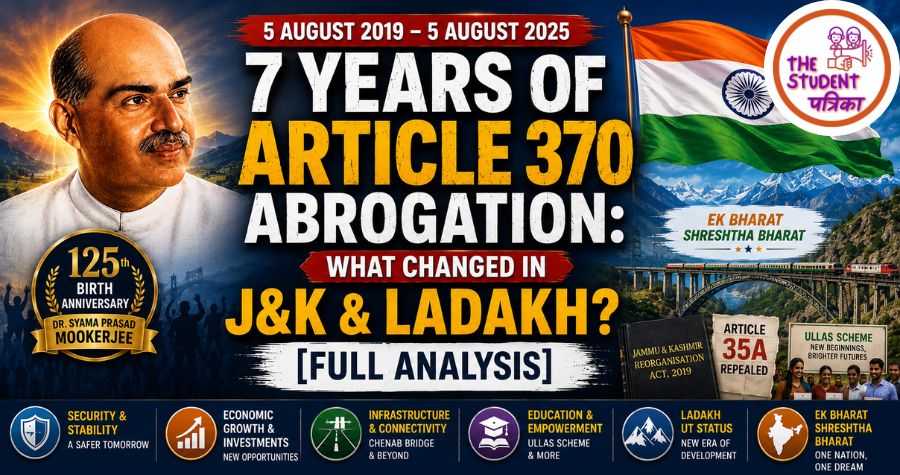
7 Years of Article 370 Abrogation: Development in J&K, Constitutional Integration & Dr. Syama Prasad Mookerjee’s 125th Birth Anniversary
On August 5, 2019, the Parliament of India passed the landmark decision to abrogate Article 370 and repeal Article 35(A) of the Constitution, ending the special status granted to Jammu and Kashmir and reorganizing the region into two Union Territories: Jammu & Kashmir and Ladakh.
Seven years after this constitutional transition, August 5 holds additional significance as India commemorates the 125th birth anniversary of Dr. Syama Prasad Mookerjee, whose vision for complete national integration found historic fulfillment in 2019.
Understanding the constitutional, economic, and historical aspects of this milestone is essential. Here is a detailed breakdown of the transformative changes in Jammu & Kashmir and Ladakh, the legacy of Dr. Syama Prasad Mookerjee, and key facts for your exam preparation.
The Historical & Constitutional Context:
Article 370 was inserted into the Indian Constitution as a temporary provision granting special autonomous status to Jammu and Kashmir, allowing the state to have its own constitution, flag, and administrative rules. Article 35(A), introduced via a Presidential Order in 1954, empowered the state legislature to define "permanent residents" and grant exclusive rights regarding property ownership, employment, and scholarships.
On August 5, 2019, the Parliament enacted the Jammu and Kashmir Reorganisation Act, 2019, which:
-
Abrogated the temporary provisions of Article 370.
-
Rendered Article 35(A) null and void.
-
Extended all provisions of the Constitution of India fully to the region.
-
Bifurcated the erstwhile state into two Union Territories: Jammu & Kashmir (with a legislature) and Ladakh (without a legislature).
This constitutional step established the principle of "One Nation, One Constitution, One Flag" across the entire territory of India.
Dr. Syama Prasad Mookerjee’s Legacy & 125th Birth Anniversary:
The 7th anniversary of Article 370's abrogation coincides with national commemorations marking the 125th birth anniversary of Dr. Syama Prasad Mookerjee (born July 6, 1901). Dr. Mookerjee was a distinguished nation builder, scholar, parliamentarian, and institution builder:
-
Academic Leader: He became the youngest Vice-Chancellor of the University of Calcutta at the age of 33.
-
Cabinet Minister: He served as independent India’s first Minister for Industry and Supply, laying the foundations for early industrial self-reliance.
-
Founder of Bharatiya Jana Sangh: In 1951, he founded the Bharatiya Jana Sangh, the political precursor to the Bharatiya Janata Party (BJP).
-
Champion of National Integration: He strongly advocated against special constitutional barriers between Jammu & Kashmir and the rest of India, famously coining the slogan: "Ek Desh Mein Do Vidhan, Do Nishan, Do Pradhan Nahin Chalenge" (One country cannot have two constitutions, two flags, and two prime ministers).
His lifelong crusade for complete constitutional integration culminated decades later when Articles 370 and 35(A) were abrogated in 2019.
7 Years of Transformation: Key Achievements in J&K and Ladakh
Over the past seven years, the full application of the Indian Constitution has driven development, social empowerment, and economic expansion across Jammu & Kashmir and Ladakh.
1. Constitutional Empowerment & Social Justice
- Extension of Fundamental Rights: Residents of J&K and Ladakh now enjoy all rights guaranteed under the Constitution of India, including the Right to Education (RTE) and the Right to Information (RTI).
- Empowerment of Marginalized Communities: West Pakistan Refugees (WPRs), Valmikis, Gorkhas, and Scheduled Tribes (STs) gained full citizenship rights, property ownership, and political reservation in local assemblies.
- Gender Equality: Women in J&K no longer forfeit their property rights if they marry outside the region, rectifying a long standing constitutional disparity under Article 35(A).
2. Infrastructure & Connectivity Push
- Highways & Tunnels: Major connectivity projects, such as the Chenab Bridge (the world's highest rail bridge) and strategic mountain tunnels, have linked remote areas with the national rail and road network.
- Hydroelectric & Renewable Energy: Substantial investments in hydro and solar power projects are addressing regional power deficits and improving grid connectivity.
3. Educational Expansion & Startup Ecosystem
- Educational Reforms: J&K achieved full literacy status under the Central Government’s ULLAS (Understanding Lifelong Learning for All in Society) initiative, reaching a literacy success rate exceeding 99%.
- Rising Startup Hub: Supported by the J&K Startup Policy, the regional startup ecosystem grew from 69 registered startups in 2020 to over 1,200 startups, with women leading nearly 35% of these enterprises across agriculture, IT, and manufacturing.
4. Economic Growth, Tourism & Traditional Crafts
- Tourism Boom: Record numbers of domestic and international tourists visit the region annually, significantly boosting local hospitality, transport, and service sectors.
- Handicrafts & Handlooms: The handicraft and handloom industries, celebrated for Pashmina, paper-mâché, wood carving, and silk carpets, support over 3.5 lakh artisans, preserving cultural heritage while generating valuable export revenue.
Key Points for Competitive Exams (UPSC, SSC & State PSCs)
-
Date of Abrogation: August 5, 2019
-
Key Legislation: Jammu and Kashmir Reorganisation Act, 2019
-
Bifurcation: Created two UTs: Jammu & Kashmir (with Legislative Assembly) and Ladakh (without Assembly)
-
Dr. Syama Prasad Mookerjee’s Birth Year: 1901 (125th Birth Anniversary observed in 2026)
-
First Union Cabinet Role: Minister for Industry and Supply (1947-1950)
-
Key Slogan: "Ek Desh Mein Do Vidhan, Do Nishan, Do Pradhan Nahin Chalenge"
-
Literacy Scheme in J&K: ULLAS (Understanding Lifelong Learning for All in Society)
The seven-year milestone following the abrogation of Article 370 represents a shift from administrative isolation toward full constitutional integration and regional economic growth. As India moves forward on its journey toward Viksit Bharat, the legacy of leaders like Dr. Syama Prasad Mookerjee continues to highlight the importance of national unity, constitutional governance, and inclusive development.
💬 What do you think? How do you view the economic and educational growth in J&K and Ladakh over the past seven years? Share your thoughts in the comments section below!
Want real-time exam updates, policy breakdowns, and study notes sent straight to your phone? Join our official Student Patrika Telegram or WhatsApp Channel right now for real time, completely verified updates directly on your phone! 📲
Related Post


Comments
Advertisement